

Many Hong Kongers might know Yusuf Mohideen from the streets of Causeway Bay, where he holds a microphone clipped onto a spatula to conduct street interviews as one of the co-hosts of Brainrot HK.
This short-form content channel has amassed thousands of followers. A sit-down conversation with Yusuf reveals many layers beyond the silly banter in 30-second Instagram Reels, depending on where you meet him.
Yusuf is a second-generation Tamilian Muslim Hong Konger who is also a neuroscience researcher, an English phonics teacher, and a mandala painter. In a digital age where social media algorithms reward repeatability and single-path niches, Yusuf’s multi-tracked path might seem like an anomaly to many. But to Yusuf, refusing to choose only a single lane is his only honest way to live.

Deconstructing Career Expectations
Growing up as the child of South Indian Muslim immigrants in Hong Kong, Yusuf’s background is atypical when compared to the majority Cantonese Chinese population, and Yusuf’s trajectory was mapped out early with high aspirations, like those of many Gen Z Hong Kongers.
“I was raised by stereotypical South Asian parents who wanted me to be a doctor,” he recalls, sharing a core memory of a hospital visit at four years old. After mimicking his South Indian doctor and checking a heartbeat with a stethoscope, his fate seemed sealed in his parents’ eyes. “They really thought, ‘This is his calling.’ Later in life, when they’d bring it up, I’d be like, ‘I could have been an actor because I was just acting!'”
Yet, Yusuf didn’t reject the sciences out of rebellion. Instead, he strove to resist rigid expectations and kept what genuinely fascinated him about studying human biology, behavior, and the mind for his bachelor’s and master’s degrees in psychology and neuroscience.
“Growing up, I’ve always envisioned myself doing everything. I wanted to understand the human mind from different perspectives, whether medical, philosophical, or through mental health, which has also become increasingly important in this day and age. It wasn’t about fitting into a pre-packaged box; it was about acquiring knowledge.”
Art Has No Bounds, and That Includes Science
Before becoming a content creator, Yusuf’s love for the arts began from a young age.
“I have always been doing art since I was young. I used to get into trouble for drawing on walls. My love for visual arts grew, and so did my love for literature during secondary school. At the time, I was writing about young love, nature, and desire. I still write and make art about those things.”
Yusuf now primarily specializes in mandala art in his free time. Mandala art is a form of intricate, symmetrical geometric design typically applied with henna during cultural celebrations, which Yusuf translates onto paper using watercolors, acrylics, and ink.
When asked how he balances being a neuroscience researcher and a multidisciplinary artist, Yusuf dismisses the premise of the question entirely. For him, the boundary between the arts and sciences is entirely constructed.
“Look at the Fibonacci sequence,” Yusuf points out. “It’s a precisely calculated physics and math formula used to illustrate the perfection of beauty. It’s pure math, but it’s also pure art. Or look at textile dyeing. You’re calculating exact ratios of chemical compounds to stain fabrics. That’s chemistry serving visual expression.”

From Dial-Up Nostalgia to “Brainrot HK”
While many associate Hong Kong with its famously East-meets-West cyberpunk aesthetic, the unique blend of corporate skyscrapers and scenic nature surrounding its peninsula has shaped many born-and-raised Hong Kongers like Yusuf.
“Every country and place has its own uniqueness, but Hong Kong has everything. I was a very bubbly, fun, talkative kid, and I loved being outdoors. I have many memories of my childhood frolicking around in nature. My secondary school was really near some mangroves, hiking trails, and waterfalls, so I was really privileged in that sense to be able to visit them right after school. We would pick mulberries from the mulberry tree, and it is a very fond memory.”
Despite his love for nature, Yusuf’s childhood was an even split between roaming outdoors in Hong Kong and scouring the Internet for Club Penguin free item codes growing up on the cusp of the digital shift in the early 2000s.
“But I also really loved my computer. I played Purble Place and the Snake game on my Nokia phone. I think those were my first hit of manufactured dopamine. I used to play Club Penguin and get so frustrated because I wasn’t a member and couldn’t get certain features, so I would search online for hacks. But none of them would actually work. Looking back, it wasn’t even that deep, but I remember praying to God to have access to the premium functions,” he laughs.
In a creator economy that demands creators “pick a niche” and stay in it, Yusuf’s multifaceted upbringing is a testament to his success. Within a few months in 2025, Brainrot HK reached 18k followers on Instagram. Yusuf’s work across media, identity, and the arts has been featured in multiple research journals and outlets, including the South China Morning Post and TEDx. Upon reflection, the spirit of Hong Kong itself has also fundamentally shaped who he is today.
“If anything, my lived experience also complements the complexity of Hong Kong. Despite how we are viewed as a city, we have so much nature and things beyond the corporate cityscape that gives it so much character.”


Rejecting the Niche in a Niche-Obsessed World
Today, Yusuf observes a generation of his peers who are overstimulated, hyper-connected, and increasingly desensitized, informed by his understanding of neuroscience and the same Internet that platformed his success in content creation.
“We live in an age of media overconsumption,” Yusuf notes, bringing his neuroscience background into his cultural critique. “Back then, if you wanted something from the Internet, you had to work for it. You had to deal with viruses, slow load times, and processing delays. The constant influx of content has numbed our dopaminergic neurons because nothing feels novel anymore. We used to go on social media to escape reality. Now we have to shut off social media just to escape into reality.”
His message to his fellow young creatives is simple: You do not owe the world a simplified version of yourself.
“People are far too complex to be reduced to a single label,” Yusuf says. “If you give yourself the room to learn and express without forcing things into a binary, you realize that everything interconnects.”
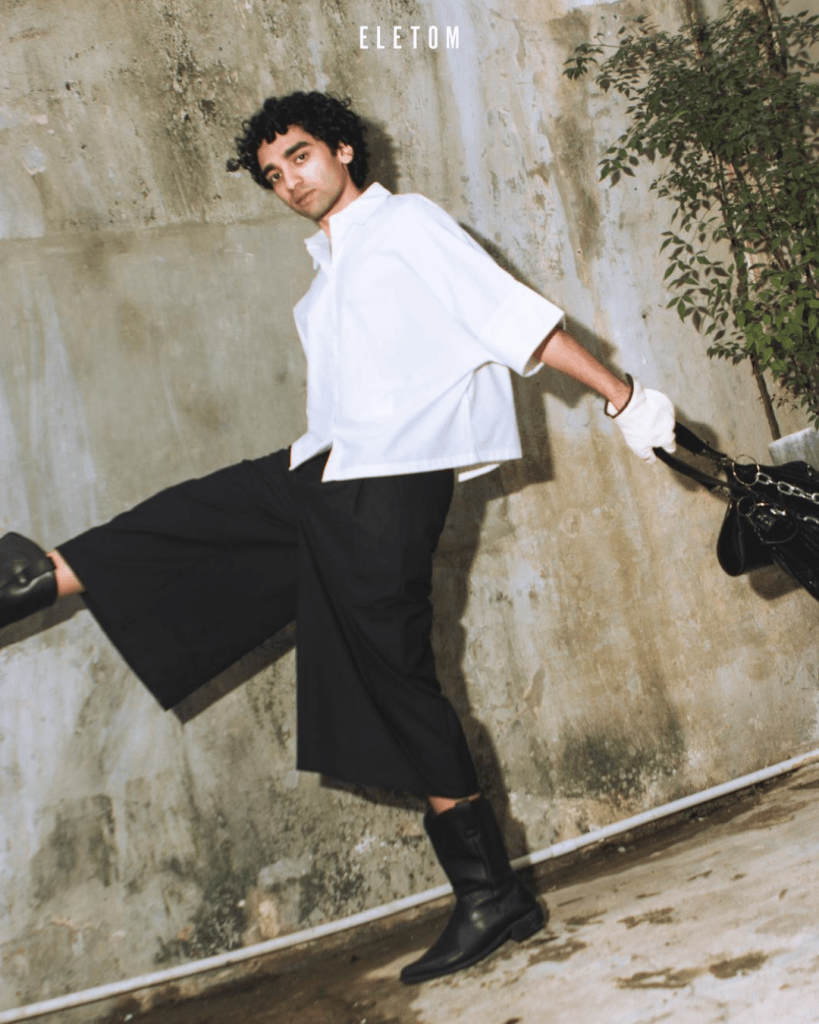
Photography: Sam So | Wardrobe styling: Samuel ML Ng
Talent: Yusuf Mohideen