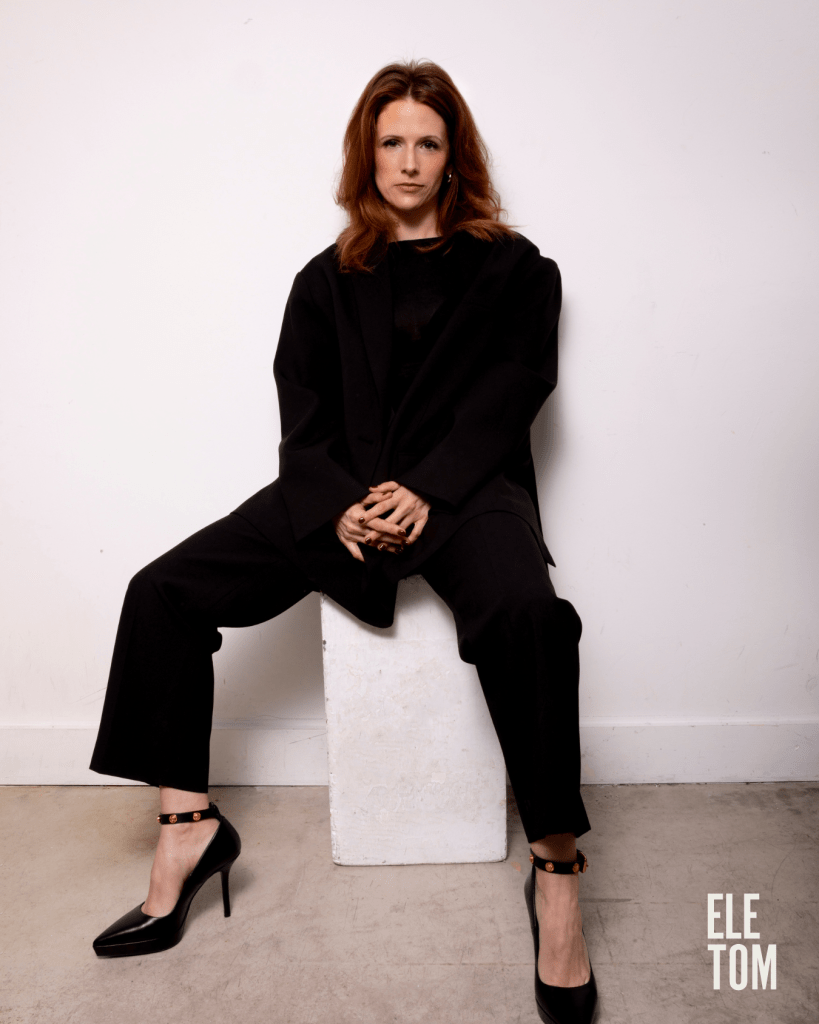
From captivating mystery roles to her activism, Victoria Broom opens up about her multifaceted career, the causes close to her heart, and why authenticity is the key to her success.
British actress Victoria Broom sat down with Eletom Magazine, enthusiastic about discussing her role as Mary Robbins in Britbox’s deliciously mysterious” I, Jack Wright,” a thriller that not only showcases her versatility as an actor but also her enthusiasm for working with renowned crime writer Chris Lang. “When I was sent the script, I instantly loved it,” she shares, settling into our conversation. “The script was so beautifully written—each character has their own complex journey within the storyline. It’s sublime.”
Broom herself is no stranger to navigating complex roles and dynamics. ( Have you seen her on Marcella yet? ) And this role made her relate even more to her character. “She’s fiercely loyal, a proud woman who takes her position within the Wright family seriously,” Broom explains. “She’s well respected, trusted, and very aware—nothing gets past Mary.” With a playful smile, she adds, “You learn more and more about her in each episode. She’s intriguing that’s for sure.”
This also applies to how she chooses her roles, for Broom, authenticity isn’t just a buzzword—it’s her guiding principle. “When I approach a character, I always find their truth and how I can pour essences of myself into them,” she reflects. “In every role I’ve done, there will be some part of me that connects to the character. Whatever the role, there will be some of my values poured into that character. Even if it’s just a tiny bit, it’s there.”
Eletom: Is there a dream role or genre you’d love to explore that you haven’t yet?
VB: Two genres really stand out for me that I would love to do more of: a thrilling courtroom drama and a restoration comedy. Two opposite ends of the scale, I know—but why paint the same picture twice?
I love to push boundaries with characters I play, and I would thrive in these two genres. Restoration comedy is such a wonderful era—it’s bold, flirtatious, gender non-conforming, flamboyant, sexy. It’s a fabulous display of inclusivity.
And I’ve always been fascinated with courtroom dramas—it’s so far from my own reality that it’s an area I would love to research and transform into.
On LGBTQIA+ Representation and Recognition
Eletom: You’ve been named one of the most influential LGBTQIA+ figures in the UK. What does that recognition mean to you?
VB: It’s very flattering… I’ve never set out to get praise or awards. I’ve always just been me and stood up for what I’m passionate about.
I am passionate about authentic queer representation on and behind the screen—from LGBTQI writers telling their stories to genuine representation on screen. I have always been vocal about this because when I was young, I never saw anyone on screen like me; there simply wasn’t that representation. I always said I would never hide who I was because it’s important for people to see themselves represented.
Eletom: How has the landscape of LGBTQIA+ representation in film and TV evolved, and what changes still need to happen?
VB: It’s changed so much. Like I said before, when I was young, there was no representation on screen. My first memory of a queer woman was the lesbian kiss on Brookside.
When I first moved to London and started attending LGBT film festivals, there was virtually no lesbian or queer female representation. I was so annoyed that I decided to write and produce my own lesbian short film and enter it into the festivals the following year. I took it around queer female spaces, put it on as a special screening at The Royal Vauxhall Tavern, and so on. It did really well because the audience of queer women was hungry for content—and we still are.
If we look at the film festival circuit now, that is very different, thankfully. And the same for TV. I’m lucky that some of my biggest TV roles have been queer female characters, and I’m proud of that fact.
There are more queer roles being written and more queer writers telling their stories—just look at how important “It’s a Sin” was. That authenticity matters. Every time I watch a show and a queer character is embedded in the storyline, I smile and feel proud. It’s important we keep going so it no longer becomes a “big deal”—it just is.
Eletom: What’s been the most powerful reaction you’ve received from someone who saw themselves reflected in one of your roles?
VB: I’ve had a few people come up to me over the years, and it’s heartwarming. I’ve received letters, art, posts, DMs. I’ve been stopped in the street and at events. Every time, it warms my heart, and I feel so much pride that by being me, people feel heard and seen.
One moment that will always hold a place in my heart: I was on the set of the BBC show “DOCTORS” a few years ago, and the Director of Photography came over to me. He said, “I knew I recognized you. My daughter came out last year, and she used to show me your Twitter profile and say, this woman is the reason I found the strength and courage to come out. She’s out, she’s in the public eye, and she works in your industry. And as a father, I want to say thank you.” Even now, years later, I remember every word. This is why I will always be me—unapologetically me.
On Her Charity Work
Eletom: You’re a patron of Bloody Good Period, which fights for menstrual equity. What inspired you to get involved, and what impact have you seen?
VB: Suffering severely with heavy, painful periods, I know how hard it can be on families to keep up with the demand of menstruating children and adults from low-income backgrounds. Period products are expensive, and not everyone can afford them.
It’s important they are freely available to every menstruating person. Why should those who menstruate have to pay for something that is natural? Period poverty is REAL, right here in the UK, it’s REAL. Bloody Good Period is trying to end the stigma and shame around periods while fighting to end period poverty. They’re a wonderful charity.
Eletom: Your work with The Stroke Association is deeply personal—can you share why this cause is so important to you?
VB: Eleven years ago, my gran died from stroke and complications from a stroke that affected her four years prior. It devastated me and my family.
None of us in the family knew anyone who had previously suffered, and we didn’t know anything about what having a stroke actually meant. Those four years before her death when she was recovering from her first stroke, The Stroke Association helped provide information and understanding, as well as speech therapy due to her having aphasia from the stroke, balance exercises, and a wider understanding of stroke rehabilitation.
A side effect of stroke that people don’t talk about is depression. To see someone you love who was active, smiling, enjoying life be taken by stroke and the depression that often follows is heartbreaking. It changes the person.
I have hosted events for Stroke Association on the active research into stroke rehabilitation they are funding. Hopefully, one day we will understand more and end stroke.
Eletom: How do you balance your acting career with activism? Do you see them as interconnected?
VB: It’s funny because I don’t see what I do as activism—it’s just me talking publicly about what I’m passionate about. I know that my truth connects with many people, especially young LGBTQI people, and I’m proud that I can be a source of light in a world that can sometimes be filled with darkness.
I will always be my truth, and I’m honored people find a connection with that. Keep shining bright.
On Personal Life and Wellbeing
Eletom: You’ve worked on an array of projects, from thrillers to dramas—how do you unwind and recharge creatively?
VB: I split my time between Central London and the South Downs. I need both the buzz and convenience of the city as well as the quiet rolling hills of West Sussex.
Being outdoors, connected to nature, walking through forests, hiking mountains… I find it so therapeutic. I switch off my social media on weekends and just be—fully present with my partner and our dog, Monty. It’s important when you have a busy life to find time to switch off.
Eletom: Outside of acting, what are you passionate about?
VB: I have SO many things I love—art, I’m a big bookworm, I play padel every week. I’m also usually found in the gym. I love weight training; five days a week at 5:45 AM, I am in that gym, even when filming. I always set that alarm early and hit the gym (even with 4 AM call times, I get my gym time in). It sets me up for the day—I feel focused and ready for the day.
I also love sleep… it’s so important to me that I have a proper night’s sleep. It recharges the body, stills the mind. People underestimate a good night’s sleep—sleep is a superpower. And on Sundays, I have lots of it!
Looking Ahead
Eletom: What’s next for you—both professionally and in your advocacy work?
VB: Project-wise, I wish I could say, but at the moment, I’m not able to share. I will soon, promise!
Advocacy-wise, I’m very proud that I have just agreed to become a mentor for a young LGBTQI person who is in the arts. Hopefully, my insight into the industry as an LGBTQI woman will help them navigate their way as a queer person in the media.
I will also be popping up around London on some panels for Lesbian Visibility Week and Pride Month to discuss lesbian representation within the media.
As our conversation concludes, Broom’s commitment to authenticity resonates as her defining characteristic—both on screen and off. In an industry often criticized for artifice, her determination to remain “unapologetically me” isn’t just refreshing—it’s revolutionary.
For more information on Victoria Broom’s upcoming appearances and projects, follow her on Instagram.
Photographer – Jemima Marriott Styling – Prue Fisher Hair & Make Up – Megan McPhilemy