
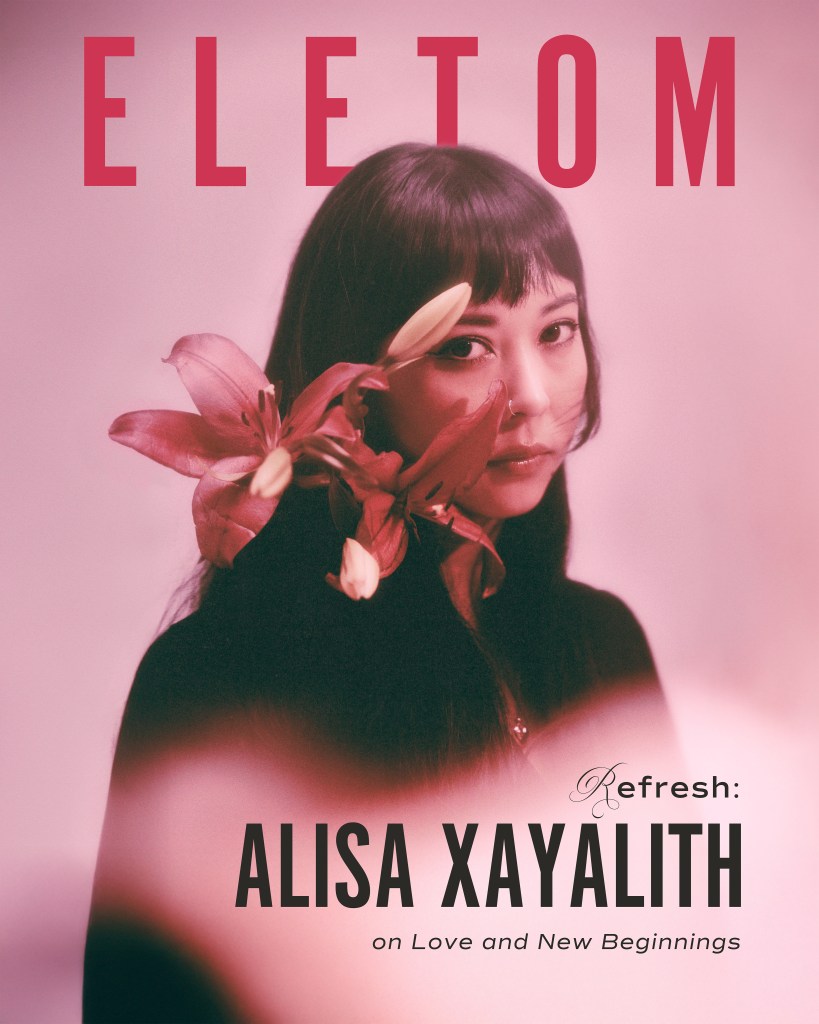
The mid-2010s were undoubtedly a time to be young, reckless, and alive. Our choices in music reflected that, as the rise of indie pop-rock and EDM became one of the core identifiers of growing up as a Millennial. In addition, we had our share of TV shows that defined our generation, and along with them came the introduction of iconic soundtracks comprised of tunes that we can still belt out today.
While everyone had a favorite, mine was New Zealand duo the Naked and Famous’s Young Blood, which I heard for the first time on an episode of Gossip Girl for a mere 30 seconds, but I was hooked, and their songs became part of my 400 song strong iPod playlist. More than a decade later, sitting on a Zoom call with me, I had Alisa Xayalith, the former lead vocalist, sharing her transition from being in the band to pursuing a solo career, emphasizing the importance of self-care and creative freedom.
Alisa was born in New Zealand to Laotian refugees who emigrated to New Zealand, and like all others during that time, they were hoping for a better life after the war. She reminisces about the first time she fell in love with music, which began at home: “My mom was always cooking at our family dinner parties. Because my dad was very good at speaking English, he helped a lot of the refugees coming in from Laos acclimate to the culture in New Zealand. We always had guests, and they would drink, eat on the mat, and sing. There would be loud folk music, and I was always singing in the house too.”
Alisa was surrounded by her aunts and uncles, who loved singing their hearts out to epic hits by Toni Braxton, Celine Dion, and Elvis Presley. But singing was considered a hobby, not a future; it was all about being practical about career choices versus following passions. “You know what I mean by this,” she says, smiling knowingly at me – to which I grin and nod. Like many Asian parents, Alisa’s father wanted her to choose a sensible career that would sustain her lifestyle in the future, but that wasn’t something she had in mind; even then, she already had her sights on the arts.

But that all changed when Alisa lost her mother. “Music was always in the house, but all of a sudden became my escape and my solace and the way to cope with what I was dealing with. From 13-14 onwards, my life changed as I lost a huge part of my culture,” she says, her resilience shining through her words.
Alisa recalls how an episode of No Taste Like Home with Antoni Porowski that made her reflect on how her mother’s passing impacted her connection with her Laotian heritage.
‘There’s an episode with Awkwafina about how and what happened when she lost her mom. She felt like she lost the language and part of her heritage. I resonated with that strongly because when I lost my mom, I felt like I lost a link to my lineage, a link to the language, a link to the culture. As a result, I don’t speak Lao. Food plays such a huge part in connecting me to my heritage. My past and upbringing and how music plays a part are so nuanced. There are so many moving parts. I wish there were a simple road map to explain how I came to be, but it’s not like that.
Her father believed education was the key to making life and attaining freedom easier. She recalls how her father would lecture her if boys called the house, saying, “You come home from school, you study, you do your homework, you go to bed, you do it again, you go to university. When you finish your studies, then you can start thinking about boys.”

But Alisa, who slowly started to fall in love with singing, began to join the school choir and talent shows and eventually found joy in singing everywhere she went with her friends. It surprised her family when she said she wanted to attend music school during a gap year. “They were rather taken aback. Honestly, they didn’t even know I sang, she laughs; middle children, as you know just fly under the radar.” During that time, 19-year-old Alisa started a band and later released a song called “Serenade” in 2006, which became the number one most-played song on college radio, to her and her family’s amazement.
“It’s funny because I look back and think, Wow, I was delusional, I had this crazy belief, stubbornness and ambition that I manifested into a reality. I’ve always lived life on my terms, and if it didn’t work for me, I would find a way to make it work.”
While Alisa didn’t come from a musical family, nor was she classically trained, she felt passionate about music, so she pursued it, becoming self-taught and learning to sing melodically. One day, she had this idea, thinking, “I want to write a song. How do I do that?” It was an interesting path, whereas most people I know who’ve done music have had classical training and piano lessons as kids. I didn’t have any of that.
“I always knew I wanted to pursue music in some shape or form, or the arts.” I was fortunate to have a clear mindset on what I wanted; when I met other people my age who would ask me if I already knew what path I wanted to be on, I always said, Oh I never had that; I always knew that I wanted to pursue music in any shape or form.”

ON FINDING HER VOICE AND HEALING
After a few minutes, Alisa and I continued conversing about her latest album, “Slow Crush,” and her decision to prominently feature her last name, Xayalith—a Laotian word meaning “Victory.”
“You got the pronunciation right out of the gate,” she said with a warm, soft laugh, which I couldn’t help but smile back. That moment then led me to ask, “Has your heritage become more central to your artistic identity with this album?”
She pauses thoughtfully, then says, “That’s an interesting question. When I started pursuing music professionally, there weren’t a lot of Asian faces, and I always felt very othered. I always felt different. We have so many Asian women in the music scene, and I feel proud to see that.
Me, just inherently existing as a Laotian person from New Zealand in the music scene, is special because there aren’t a lot of Lao women. I don’t know any other indie Lao musicians making the same kind of music, infiltrating the same culture or niche.”
That was when I asked her, “Why did you go solo after so many years of being part of the band? “Well, I was in a band with, like, all white boys,” Alisa reflects, her voice carrying the weight of years spent navigating complex creative dynamics. Her main collaborator, Thom Powers, served as both producer and co-writer, creating a successful partnership but not without challenges.
“Tom and I would write all the music and the lyrics together,” she says, starting her story; that was when she opened up about her band years, offering a candid glimpse into the often-overlooked realities of collaborative artistry.

Even though she was the lead singer and songwriter, Xayalith frequently found herself caught in a delicate balancing act. “Creating in that kind of ecosystem is probably one of the hardest things to navigate because you also have to navigate people’s expectations and tastes,” she says.
After functioning within this state for 15 years, Alisa became so used to the extremes, that is, both functional and dysfunctional versions of creative collaboration. “There’s a healthy version of what that ecosystem looks like, and there’s an unhealthy version of that system,” she observes. “Often it was a pendulum swinging from one extreme to the other, and I lived inside that little microcosm.”
The turning point came when Alisa was so creatively and mentally drained that she stepped out. Around that time, she started thinking about how to improve herself. After taking time off and going to therapy, Alisa questioned whether she could start creating music that speaks to her soul, sustains her, and keeps her happy. Those were her burning questions, and sooner rather than later, she found herself once again.
Having friends who remind you of who you are and practicing gratitude—as cheesy as it sounds—actually works. It rewires your brain.”

HER ARTISTIC REBIRTH & SLOW CRUSH
Slow Crush navigates her years of love, heartache, and self-love. Her lead single, ‘Kiss Me Like You’re So in Love,’ represented one facet of her artistic rebirth. “I thought my album was done before that song came along,” she admits. Written in Norway with Matthias Tellez and her husband Tyler Spry, the song emerged from a place of
“I was kind of playing a character in this song, conjuring this Debbie Harry, Patti Smith persona. It was so fun,” she says. “The album is filled with songs of yearning, love, and heartache—it holds experiences and memories from a time when I was coming of age as a late bloomer into my career, my life, myself.”
Working with her husband, Tyler, has been particularly transformative. “Having a partner who understands you so innately was the most liberating gift I could have,” she explains. “During the pandemic, he sat me down in my hour of need and asked, ‘What do you want? No judgment. Tell me, and I’ll support you however you need.'”
HONORING HER PAST, EMBRACING HER FUTURE

“I don’t think my mother would have ever dreamt that my life would be like this,” Alisa says, smiling sadly, “but I am so grateful for it.” She recalls how her parents and two siblings lived in a refugee camp for three years before being flown to NZ to start a new life before eventually making her way to New Zealand.
At that time, as we were starting to edge closer to our conversation, I had to ask – When asked how the artist she’s become connects to the young woman trying to find her voice in New Zealand years ago, Xayalith becomes emotional. “That question makes me so emotional. In therapy, I’ve been talking about how taking care of my creativity means taking care of my inner child—that 10-year-old girl who lost so much and had a hard time.”

“I’ve been honoring her, protecting her, letting her feel safe in her creativity, approaching it without judgment but with kindness, grace, and love,” she continues. “That played a massive part in my growth as an artist. I learned how to protect and cultivate this creative relationship with myself by honoring the young girl who had such big dreams to get out of state housing, to write songs, to live a beautiful life making music.”
With pride in her voice, she adds, “And we went through a lot together. I finally got to a point where I can say, ‘I got you. We did it. We frickin’ did it.'”
What’s the next step? Alisa now faces a new challenge: performing these songs live. “Can I perform these songs, stand on the stage and be a performer again?” she wonders. “I have not ever experienced that without my band in 15 years of doing this professionally.”
Preparing for her upcoming tour with Sunday (1994), she’s starting from scratch with her live setup. “I’m going to have to play guitar, figure out how to put a set list together—everything. I haven’t performed on stage since 2020.”
Despite the nerves, she’s embracing this next chapter. “I haven’t acquainted myself with the performer I used to be for a long time, let alone in this version of myself. It’s a little nerve-wracking but I’m very excited about it.”
As we ended the conversation on a high note, I left thinking that Alisa’s journey as an artist is not unlike our journeys of self-reflection and healing. It serves to inspire others who, like her, are out to claim their identities and victory.
For more on Alisa’s new single and upcoming tour, follow her on Instagram and Youtube: @alisaxayalith
Image Credits: Frances Carter | Editor-in-Chief: Natalie Tran Steger | Cover and Graphics: Alexander Silkin