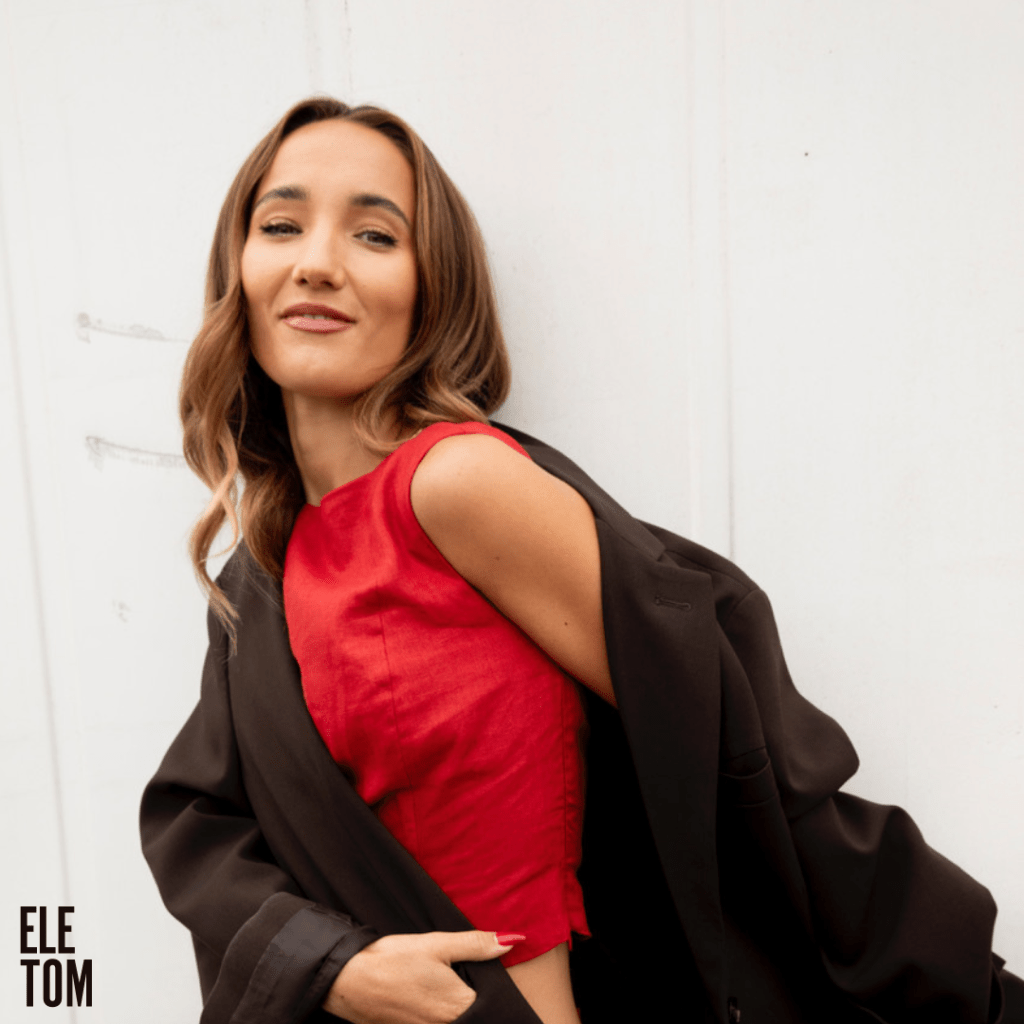
Rising actress, producer, and writer Lucy Heath is a force to be reckoned with on British TV and theater stage. Known for her role on Sweetpea with Ella Purnell as Lucille she was able to inject her sharp wit into the role, the show eventually earned rave reviews with Rotten Tomatoes with a near-perfect score. This time, she decided to put her writing cap on by not only writing the script for PRAGMA but also starring in the lead role alongside Ted Lasso Star, Phil Dunster.
Heath chats with us today, as she discusses her creative process as a writer,actress and new projects on the horizon.
Let’s take a step back a little bit in time. Could you recall that special moment when you developed your curiosity about the world of acting and storytelling? Was there a particular film or book that caught your interest?
I remember being obsessed with Pocahontas as a kid, I would pause the film scene by scene, write the dialogue and the songs down so I could act out all the characters as the film played. I actually did this with most Disney films and would force my neighbour, Timmy, to play all the boy parts (Sorry Tim).

Do you remember your first role and how that later shaped your interest in acting?
My first role was in year six when I played Aladdin in Aladdin – which I’m sure led me to have a prematurely inflated sense of importance. Then the first acting role I really remember, with a more mature brain, was playing Abigail Proctor in our senior school production of The Crucible – my dad maintains this is the best performance I’ve ever given (which feels good). It was the first time I really remember consciously making acting choices that landed with an audience, which helped me learn to trust my instincts. It also made me crave these more ‘morally dubious’ roles, characters like Villanelle in Killing Eve appeal to me the most. It was, in retrospect, a bizarrely star-studded school production with Phil Dunster playing John Proctor and Eliza Bennett as Goody Proctor – we should have charged way more.
Three people you look up to and why?
Sharon Horgan – From what I know of her, she’s worked incredibly hard to launch the career she has now. I think Merman produces some excellent TV shows and her level of comedic acting and writing is a rare find.
Emma Thompson—She’s a phenomenal actress who hasn’t fallen victim to the Hollywood archetype of what a woman needs to be to be successful. She’s incredibly bright and articulate and actively fights to make the world a better place.
Brooke Parratt—She’s one of my best friends and the kindest, most good-willed person I’ve ever met. I aspire to be more like her on a regular basis.
What has your experience been like so far as an actor? What challenges have you encountered, and how did you overcome them?
My biggest challenge by far was not getting any auditions after graduating drama school, I’m actually relatively new to auditioning! It’s tough to value yourself when you feel invisible – my heart goes out to anyone who’s struggling to get seen by casting directors. HOWEVER it made me start making my own short films, which was the best decision I ever made! Making shorts totally redefined my relationship with the industry and made me see the value I had to offer.
Since Sweetpea has recently received rave reviews, tell me about what drew you to the project and what it has been like to work alongside Ella Purnell.
I’m a big fan of See-Saw as a production company, so when I saw it was one of their projects, I was very excited, and I trusted it would be a good show. Ella is a delight to work with. She has been acting since the womb, I believe, so it was really inspiring to see how comfortable she was on set. She never pushes her performance, which is why you’re so intrigued by her. She draws an audience in—10/10 would recommend.
What’s your creative process like when trying to immerse yourself in a new role, and how did that play a part in your role as Lucille in Sweetpea? Were there some aspects of her story that resonated with you the most?
I always try and build a three-dimensional world for my character to inhabit. In life we’re the sum of so many different interactions/ lived experiences, so I’ll try and apply that to each character – where do they live now vs where they grew up, how do they interact with their colleagues vs their lovers or friends.
If it’s a smaller role I’ll fill in the gaps myself – like where has she just come from before this scene began? I think that helps those smaller parts still feel alive. I think with Lucille, ultimately, she just wants to be part of the ‘in crowd’ which we can all resonate with in some degree – whether it was as teenagers or even within the industry – trying to ‘fit in’ can make people feel disingenuous.
Could you share some fun backstage stories that happened on set?
It’s never a dull moment with the queen, Camille Coduri, around. As she was reading a fellow cast mate’s palm, my friend Jess Brindle (A.K.A Pidge) threw a piece of rubbish that landed square in the bin and, without taking a beat, Camille said, “buy a lottery ticket,” so on our lunch break Jess bought one and won £5! What a day to be alive.
Moving forward, let’s talk about Pragma. You took on multiple roles of actor, writer and producer for this film. Can you tell us more about the story behind Pragma and what it was like balancing the different roles on set?
The story came from years of being rubbish at romantic relationships. I honestly just didn’t understand them and so I would always want to run away to the safety of my friendships. I would watch my friends be so happy in love, and I remember saying to one of them – I wish I could just go to a school for love where they assign me a partner, and we learn how to be in a healthy relationship together – and thus, PRAGMA was born.
I find taking on producing roles whilst acting in short films really tricky – I remember taking lunch orders between takes, or bookings everyone’s taxis at midnight each night. However writing your own work, then getting to play with actors on set as they bring your words to life, is the most thrilling feeling in the world.
PRAGMA had a dream team behind it, including Phil Dunster, Ellie Heydon and Jason Sudeikis as an executive producer. How did this collaboration come about, and what was the experience of bringing PRAGMA to life?
So as I mentioned re-The Crucible, Phil and I went to school together, he was a couple of years above me and I had always looked up to him for industry advice. I had just made my first short film, Better, and then after that Phil and I decided we wanted to make a short film together so we could stretch our creative muscles rather than wait around for work.
We were exploring the themes of love, dating and relationships – which then inspired the idea for PRAGMA. Ellie is Phil’s partner and had directed a couple of great short films before, she’s as obsessed with romantic philosophy as I am, so it felt like the obvious choice to have her direct it! Phil had just filmed season one of Ted Lasso, and Jason Sudeikis very kindly gave us some money for the short and attached his name as an EP, which massively helped us pitch the series, and I’m very grateful! I had been to a bunch of short film festivals with my first short, Better, so I had made a note of all the HOD’s I loved from various festivals and then reached out to them to come on board for Pragma.
As an actor, writer, and producer, you’re building a diverse portfolio early on. How do you balance these roles, and what do you love most about each?
Being totally honest, producing shorts is hell. My condolences go out to anyone who’s currently producing a short film. I only do it to get my stuff made—my brain is far too scatty for that.
I always say that acting is the most joyful part of my life but writing is the most fulfilling. Acting is just ultimate play and freedom – you’re being paid to do what you used to do in the playground, imagine worlds and completely immerse yourself in them – what a privilege! I find writing much harder work, but you get to explore the never-ending questions in your brain, if I didn’t have an outlet for those thoughts, I would feel like that part of my brain was being wasted now. Also, being a writer makes me feel much more empowered, it feels like more of a meritocracy than acting. If you’ll forgive the cringe – acting is for my heart, but writing is for my soul.
You have a podcast dedicated to the writing and creative process. What inspired you to start this, and what do you hope listeners take away from it?
I think writers and the writing process are really overlooked – the time and care that goes into crafting a story goes so much deeper than I ever considered before I started writing. If I’m totally honest, I was getting quite frustrated with how long the writing process takes and people asking why my show’s not on TV yet. It’s like asking someone why they have not won the Olympic gold yet – it’s an incredible feat to achieve! So I wanted an outlet to discuss what it’s really like writing for TV – and also just to have a laugh with my very funny friend, Lauren Soley. We’re writing a new series, The Bull Ring, together, so our aim is to give a real, lighthearted peak behind the curtain throughout the process of trying to get a TV show Greenlit – which is why the podcast is called Lets Get Sh*t Greenlit.
Are there any unique challenges or rewarding moments from your writing and producing journey that you’d like to share with aspiring creators?
When we had the original PRAGMA screening, quite a few people came up to me and quoted my writing back to me, telling me how much it resonated with them—that was really special. The same happened when we went to the Tribeca Film Festival. Some rather famous people quoted moments from my writing that they had loved. In those moments, I felt really proud of myself and the work we’d all put in to tell this story.
For more on Lucy, follow her on her socials.
Credits: Photographer – @jemimashoots | HMU – @jessbonwickmua |Publicist – @satellite414screen