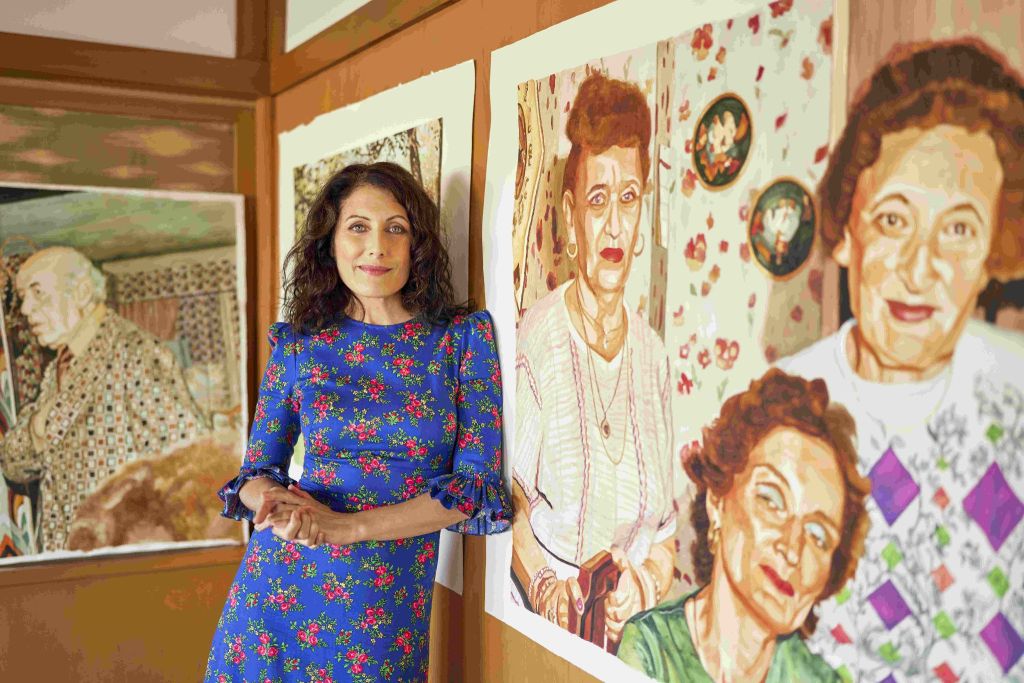
For centuries, people have cultivated an appreciation for painting and the arts, and eventually, it inspired others to bring their ideas and concepts to life. Lisa Edelstein is one of these individuals — as an established actress in Hollywood, she became known for her roles in “House”, “The Good Doctor”, “Girlfriend’s Guide To Divorce”, “The Kominsky Method” and most recently, “Little Bird.” 
She found herself revisiting one of her past times during the lockdown to deal with the downtime that comes with being at home. After picking up a paintbrush, Edelstein felt a fresh wave of emotion and inspiration that pushed her to transform a dearly loved hobby into a full-on visual practice that drove her to develop the singular characteristics that made her work incredibly unique.
Now, Edelstein is breaking into the art world with her first exhibition, a series of paintings intimately called ‘The Den’ at Anat Ebgi Gallery.
Congratulations on your solo exhibition! I would love to know about your early interest in art. Can you recall a particular memory about your first foray into painting?
Thank you so much! It’s been so lovely to have drawing and painting back in my life in such a profound way. As a kid, I spent enormous amounts of time drawing whatever was closest to me. Coloring with markers was a pastime well into high school. But painting was a whole other beast. I painted a bit in high school but then put it away while pursuing my career as a performing artist. Drawing became a part of my private life, something I did for myself.
I have journals filled with them from my whole adulthood. It wasn’t until the lockdown that I permitted myself to not only indulge in the time I wanted to spend making objects but to allow myself to consider showing the results to anyone outside my friends and family.

Installation View

Stoop, 2022
You’ve always been a constant creative with your work as an actress, producer, playwright and philanthropist. What inspired you to pursue a career in painting? Were there any specific events or experiences that triggered this new experience?
The lockdown happened. I don’t do well with downtime. I need to be making things, writing, performing, and being in the act of doing. So that was the energy that propelled me back into drawing, markers, and paint. And it was exciting to realize I had access to storytelling in another medium. Because my husband is such an incredible artist, as are many of our friends, I had some of the most astonishing studio visits from the get-go. Andrea Bowers and Charles Gaines debated whether to study the color chart or work instinctively. Edgar Arceneaux and I discussed the source of my images. Bill Leavitt came, Rodney McMillan. I mean, I am surrounded by an incredible community of artists. I didn’t decide to make this a new career.
I committed to having an actual visual arts practice. It’s not something I do in my downtime. It’s something I do. There is pressure on creative people, especially women, to pick a lane and stay put. But that’s not the way I function.

Who else has helped you hone your style besides your husband? And what made you specifically want to work with watercolors as a medium?
I wouldn’t say Robert helped me hone my style, but he was great about critiquing what I was doing, asking me questions, and just pure supportiveness. He and our friends have shown me many other artists to look at and be inspired by, giving me an incredible education. I am soaking in incredible teachers! I began with markers, something I’d loved as a kid and had revisited in my twenties. But as my images became more complex and grew, I kept running out of ink.
So, I switched to marker refill ink and began to paint with that. I liked working with watercolor paper because the texture was beautiful, and I wanted to see how the ink moved. But the images grew in size again, and ink didn’t travel across the paper very quickly. That’s when I decided to try watercolor instead. It’s been about what medium feels best and what I enjoy working with. I’ve also done many oil paintings, and I enjoy going back and forth between mediums.

Home movie: The Stroll, 2022
Tell me more about the Den. When did that eureka moment occur when it came to conceptualising and turning family photographs into the central theme and inspiration behind your paintings?
I moved my parents to Los Angeles during the lockdown, and in doing so, they downsized and dumped hundreds of pictures and home movies on me. It was a treasure trove going back to the 1920s. What I loved about the old film pictures were the captured moments, the unposed, and the images that revealed unintended narratives. People saved all their photos since they were expensive to develop. So there were incredible little gifts in that massive pile. It’s a discovery process similar to how I’ve been working my adult life – storytelling, set-making, scene-writing… I also love working with damaged photos and blurriness, challenging myself to trust the shapes and not worry about the hidden image.
What made you want to choose the name The Den?
In talking with Anat about the contents of this show, we realized the very concept of The Den was something from a time ago. People don’t have dens anymore; they don’t gather around the TV like they used to, and the internet has replaced the encyclopedias that used to line our walls. So it felt transportive to call the whole show The Den. You know you are immediately entering into a time that no longer exists.

Flowers, 2022
You’ve been heavily surrounded by creatives for a significant amount of time, and your exposure to the art world has evolved in many ways. Alive or dead, who are some of the most influential artists that have influenced your work, one way or the other, and which ones would you love to collaborate with
Growing up, all I wanted was to be on stage. Any stage. Tap dance, jazz, modern, and any play that would cast me, I had an unending need to be performing. Then, as a teenager, I submerged myself in the NYC subculture, a world with Warhol, Keith Haring, Kenny Scharf, David LaChappelle, and all kinds of performance art. The playfulness and freedom that came out of that time was unlike any other as it coincided with and was perhaps responding to the AIDS pandemic.
My entire community was rapidly rocked by death after death and continued to be for a decade. So while studying experimental theater at NYU, I left school to create my show about the crisis, Positive Me, which was produced and performed at La Mama ETC. I say all this because I think that period shaped me as an artist in whatever I do. I was surrounded by brains gone wild, and I am enormously grateful. Beyond that, I have been motivated by photography and film.
Nan Goldin comes to mind because her images suck you right into the moment, either because you can relate, you can remember, or you are learning. But you are in there with her. Robert and I have spent hours at museums, staring at the Dutch Masters, ogling over miraculous brush strokes. And I am continuously amazed at the output of my friends, like Andrea Bowers, whose drawings are insane and whose content is endlessly powerful. As for collaboration, I’d love to sift through my friend Patrick McMullan’s endless supply of social photography. He’s captured generations of partygoers and performers. His ability to befriend his subjects makes many pictures personal and honest.

Can you share some insights into your creative process as a painter? Do you have any specific rituals or routines that help you get into the right mindset for creating art?
I spend hours sifting through old photos, looking for what compels me to dive into that moment. I love painting, so I don’t need the mindset to change. I need the time. I will paint for ten hours or until my back goes out. The problem is forcing myself to stop.

Bong, 2022
Since your art will evolve in the coming years, what messages or emotions do you aim to convey through your work, specifically with The Den?
It’s so close to acting. For me, the goal is always to create an empathetic response, for people to see themselves or someone they know in the work. It’s deeply personal, even when I don’t know the subjects. I hope there is always a story in the images that penetrates the viewer’s imagination.
For more on Lisa, follow her on Facebook